India’s Next Leap with Dr. Sanjay Kumar, An Eye-opening Call to Youth
Some events feel less like a lecture and more like a genuine conversation you didn’t know you needed and this session on 27th November at Indira University was exactly that. India’s Next Leap with Dr. Sanjay Kumar embodied that vibe. The afternoon was warm, honest and powerful.
The session opened with the arrival of Dr. Tarita Shankar, President Designate – Indira University, Chairperson and Chief Mentor- Indira Group of Institutes, whose presence always adds a certain energy to the room. Soon after, Mr. Ashutosh Misal set the mood with a reminder from Swami Vivekananda: when you pick one idea and truly live by it, everything else falls into place. He called today’s youth “lions,” capable of taking charge of everything they believe in and the room felt that confidence instantly.
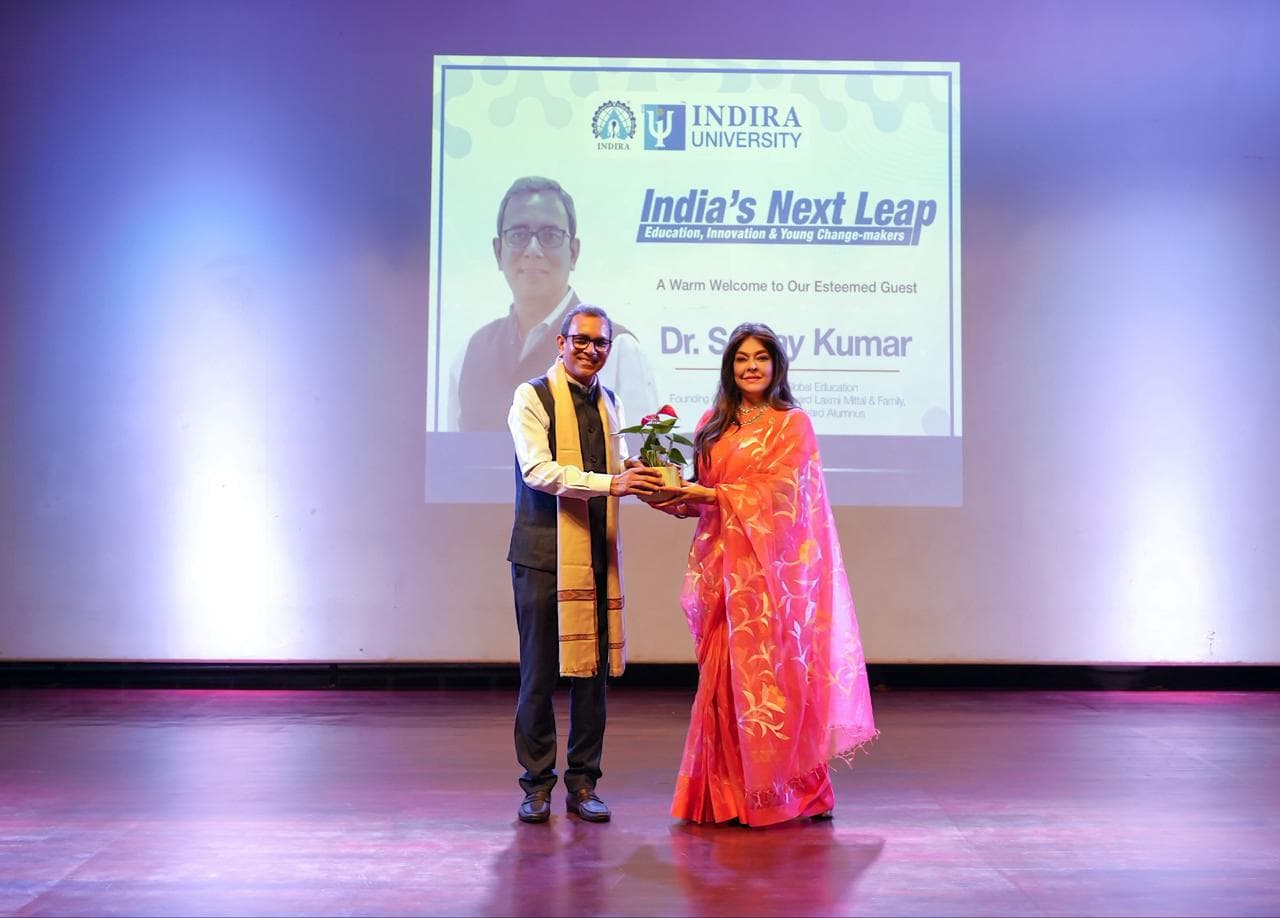
Once Dr. Sanjay Kumar, a Harvard educated scholar, bestselling author and national spokesperson of the JDU, was welcomed and felicitated, the session eased into a free flowing conversation. What made it special was how naturally he spoke. No heavy jargon, no complicated theories, just real life stories and reminders. He was insightful.
He began by talking about India’s changing landscape, especially how innovation today is popping up in the most unexpected places, which is rural classrooms, small communities, student groups and even youth-led side projects. According to him, the next big transformation won’t come from boardrooms alone, but from young people who stay curious and stay connected to the ground.
Dr. Sanjay also shared the vision for India@2047, a country that is inclusive, innovative, cleaner, more aware and led by young citizens who aren’t afraid to take responsibility. He spoke about equity, education gaps, climate stress and the need for purpose-led learning in a way that felt relatable, not overwhelming.
One of the most engaging parts was the Q&A.
When he asked, “Do you think India can become a developed nation by 2047?”, a student replied that strong education systems and institutions make all the difference.
To another question, “What does development mean to you?”, a student shared that unless educational inequality is reduced, progress will always feel uneven.
What stood out throughout the session was how grounded Dr. Sanjay remained. Whether he spoke about his childhood in Bihar, his experiences at Harvard, or his work with communities, every story pointed to one idea that change begins when you step out and engage with the issues the world is battling right now.
As the event wrapped up, students walked out with clearer thoughts, lighter hearts, and a stronger sense of belief.
This was Dr. Sanjay’s second visit, and it left everyone quietly hoping for his upcoming events.