B.Sc. (Economics)
Turn insights into impact, chart your path in policy, finance, economics, and global change, and become tomorrow’s decision-maker with a B.Sc.(Economics) at Indira University!
Study Mode
Full Time
Duration
Graduation - 3 Years & Honours & / or Research - 4 Years
Commencement
July 2026
Assessment
Semester
Location
Indira University, Tathawade , Pune
Overview
B.Sc. (Economics) under the School of Commerce and Computer Applications provides a comprehensive understanding of economic systems, decision-making, and resource management. This program explores fundamental concepts in microeconomics, macroeconomics, econometrics, international trade, and labour economics, blending theory with practical application. Students develop strong analytical, quantitative, and research skills, enabling them to interpret data, evaluate policies, and understand market behavior. Emphasis is placed on critical thinking and real-world problem-solving through case studies, statistical tools, and economic modeling.
The curriculum equips students to analyze economic trends, assess financial risks, and make informed decisions in both public and private sectors. With exposure to classroom instruction, simulations, and project-based learning, students gain a well-rounded foundation in economics. Students can pursue careers in banking, finance, consulting, policy analysis, and market research, or opt for higher studies in economics, public policy, or business analytics. The program is ideal for those curious about global markets and economic impact.
Why pursue B.Sc. (Economics) with Indira University?
 Rajdeep Gaikwad,
Credit Suisse Ag, ENO (exempt non officer) Compliance
Proud to say that this course is well crafted with the curriculum that is only available at our Institute which brings the best out of every student. The faculties bring in experience along with vast knowledge of subjects that it becomes very easy for students to understand the subjects who earlier belonged to different stream.
Omkar Sambhaji Bhondve,
B. Com(FM), Pune, Businessman
It gives me a great pleasure today with pride that I’m studying in environmental health and safety management from Indira. The relationship between faculties and student is very cordial, which gave me an opportunity to excel in my area of interest. The two-years spent here were splendid and has helped me to grow better professionally and personally. I would like to thank Indira College and all faculties for making me a Better person.
Mr. Mangesh Bhagwat Pawar,
StateStreet HCL, Financial Analyst
I got placed in State Street HCL It is because of the efforts put by our College faculties and Placement Cell. Indira provides great exposure to students by organizing different activities which are very much helpful for deciding their future field. I feel great studying at Indira as it gives great opportunity as well as support from faculties and placement officers. Acquiring placed in State Street HCL is an accomplishment for which I would like to thank to Indira.
Learning Experiences
At Indira University, B.Sc.(Economics) program offers more than just academic learning; it provides an industry-relevant, immersive educational journey. The curriculum seamlessly combines theoretical foundations with practical exposure. Students have opportunities to engage in live projects, participate in internships, and explore real-world business challenges.
Under the mentorship of experienced faculty and industry professionals, learners build strong technical and interpersonal skills to succeed in the rapidly changing global market. We offer a platform where students can innovate, gain valuable experience, grow professionally, and lay the groundwork for a thriving career.

Curriculum
| SEMESTER-I | ||
|---|---|---|
| Nature of the Course | Title | Credits |
| Mandatory Major | Principles of Microeconomics | 4 |
| Mandatory Major | Mathematics for Economics I | 4 |
| Minor | Elementary Statistics | 2 |
| Open Elective/Generic Elective | Elective from other Discpline | 2 |
| Vocational Skill Coure | Data management with Excel | 2 |
| Skill Enhancement Course | Personal Financial Planning- I | 1 |
| Skill Enhancement Course | Decoding AI | 1 |
| Ability Enhancement Course | English Communication Skill | 2 |
| Value Education Course | Essentials of Sustainability | 2 |
| Indian Knowledge System | Introduction to Indian Knowledge Systems (IKS) | 2 |
| Total | 22 | |
| SEMESTER-II | ||
|---|---|---|
| Nature of the Course | Title | Credits |
| Mandatory Major | Principles of Macroeconomics | 4 |
| Mandatory Major | Mathematics for Economics II | 4 |
| Minor | Intermediate Statistics | 2 |
| Open Elective/Generic Elective | Elective from other Discpline | 2 |
| Vocational Skill Coure | Data management with Advanced Excel | 2 |
| Skill Enhancement Course | Basics of Accounting | 2 |
| Ability Enhancement Course | Academic Writing | 2 |
| Value Education Course | Constitutional Values, Fundamental Duties and Political System in India | 2 |
| Co-Curricular Courses | SOUL | 1 |
| Co-Curricular Courses | NSS/ Cultural Activities / Fine Arts / Performing Arts / any other equivalent | 1 |
| Total | 22 | |
| SEMESTER-III | ||
|---|---|---|
| Nature of the Course | Title | Credits |
| Mandatory Major | Intermediate Microeconomics | 4 |
| Mandatory Major | Introductory Econometrics | 2 |
| Mandatory Major | Development Economics | 2 |
| Minor | Advanced Statistics | 4 |
| Open Elective/Generic Elective | Elective from other Discpline | 2 |
| Vocational Skill Coure | Software Tools for Economics (Lab Based) | 2 |
| Field Project/Community Engagement Project | Field project – I | 2 |
| Ability Enhancement Course | Hindi-I | 2 |
| Co-Curricular Courses | NSS/ Cultural Activities / Fine Arts / Performing Arts / any other equivalent | 2 |
| Total | 22 | |
| SEMESTER-IV | ||
|---|---|---|
| Nature of the Course | Title | Credits |
| Mandatory Major | Intermediate Macroeconomics | 4 |
| Mandatory Major | Applied Econometrics | 4 |
| Mandatory Major | Public Finance | 2 |
| Minor | Probability Theory | 2 |
| Open Elective/Generic Elective | Elective from other Discpline | 2 |
| Field Project/Community Engagement Project | Community Survey | 2 |
| Skill Enhancement Course | Career Readiness Module (GRE/UPSC/Placements) | 2 |
| Ability Enhancement Course | Hindi-II | 2 |
| Co-Curricular Courses | NSS/ Cultural Activities / Fine Arts / Performing Arts / Research paper / Industrial visit any other equivalent | 2 |
| Total | 22 | |
| SEMESTER-V | ||
|---|---|---|
| Nature of the Course | Title | Credits |
| Mandatory Major | Indian Economy | 4 |
| Mandatory Major | Cost Management | 2 |
| Mandatory Major | Economics of Digital Platforms & FinTech | 4 |
| Major Elective | Industrial Economics / Foreign Exchange Market | 4 |
| Minor | Economic Modelling & Forecasting | 4 |
| Vocational Skill Coure | Personality Development | 2 |
| Field Project/Community Engagement Project | Field Project-II | 2 |
| Total | 22 | |
| SEMESTER-VI | ||
|---|---|---|
| Nature of the Course | Title | Credits |
| Mandatory Major | International Economics | 2 |
| Mandatory Major | Public Policy Evaluation Methods | 4 |
| Mandatory Major | Economics of Startups and Innovation | 4 |
| Major Elective | Equity Market / Investment advisor | 4 |
| Minor | Practical Training Using Software Tools | 4 |
| On the Job Training/Internship/Apprenticeship | On job Training / Internship/ Field project | 4 |
| Total | 22 | |
| SEMESTER-VII (Hon.) | ||
|---|---|---|
| Nature of the Course | Title | Credits |
| Mandatory Major | Introduction to Energy and Environemental Economics | 4 |
| Mandatory Major | International Finance | 4 |
| Mandatory Major | Labour Economics | 4 |
| Mandatory Major | History of Economics Thoughts | 2 |
| Major Elective | Commodity market/Finance Associate | 4 |
| Research Methodology | Research Methodology | 4 |
| Total | 22 | |
| SEMESTER-VIII(Hon.) | ||
|---|---|---|
| Nature of the Course | Title | Credits |
| Mandatory Major | Development Economics & Policy Impact Evaluation | 2 |
| Mandatory Major | Risk Analysis & Economic Uncertainty | 4 |
| Mandatory Major | Quantitative & Qualitative Research Techniques for Economists | 4 |
| Mandatory Major | Gender Economics | 4 |
| Major Elective | Public Economics / Advanced Behavioral Economics | 4 |
| On the Job Training/Internship/Apprenticeship | On the job Training / Internship/ Field project | 4 |
| Total | 22 | |
| SEMESTER-VII(Research) | ||
|---|---|---|
| Nature of the Course | Title | Credits |
| Mandatory Major | Introduction to Energy and Environemental Economics | 4 |
| Mandatory Major | International Finance | 4 |
| Mandatory Major | Labour Economics | 2 |
| Major Elective | Advanced Econometrics / Financial Econometrics | 4 |
| Research Project | Empirical Economic Research Project | 4 |
| Research Methodology | Research Methodology | 4 |
| Total | 22 | |
| SEMESTER-VIII(Research) | ||
|---|---|---|
| Nature of the Course | Title | Credits |
| Mandatory Major | Development Economics & Policy Impact Evaluation | 4 |
| Mandatory Major | Risk Analysis & Economic Uncertainty | 4 |
| Mandatory Major | Quantitative & Qualitative Research Techniques for Economists | 2 |
| Major Elective | Public Economics / Advanced Behavioral Economics | 4 |
| Research Project | Final Research Dissertation | 8 |
| Total | 22 | |
Pedagogy
The teaching methodology at Indira University emphasizes a dynamic and interactive learning environment. It includes diverse approaches such as the lecture method, role plays, management games, presentations, and case-based studies. Students actively participate in seminars, research projects, and field visits to enhance their practical understanding. ICT-enabled classrooms support digital learning, while activity-based learning encourages engagement and creativity. Additionally, guest lectures and workshops by industry experts and alumni offer valuable industry insights, bridging the gap between academic concepts and real-world applications. This multifaceted approach aims to develop critical thinking, communication, and problem-solving skills essential for future professionals.
Key Points:
- Lecture Method
- Role Play
- Management Games
- Presentation and Case-Based Study
- Seminars by Students
- Use of ICT-Enabled Classrooms
- Activity-Based Learning
- Guest Lectures and Workshops by Industry Experts and Alumni
- Research Projects and Field Visits
Industry Immersion
At Indira University, students obtain valuable industry exposure through internships, industrial visits, workshops, guest lectures, alumni interactions, and collaborations with leading businesses. These opportunities help students practice their academic knowledge in real-world settings, understand emerging industry trends, and engage with the professional community. This immersive approach strengthens their practical skills and builds strong networks that improve their future career prospects.

Mapro

Students explored the entire supply chain and production processes of the food and beverage industry. They learned about manufacturing practices, quality control measures, branding strategies, and the operational challenges involved in managing a consumer brand.
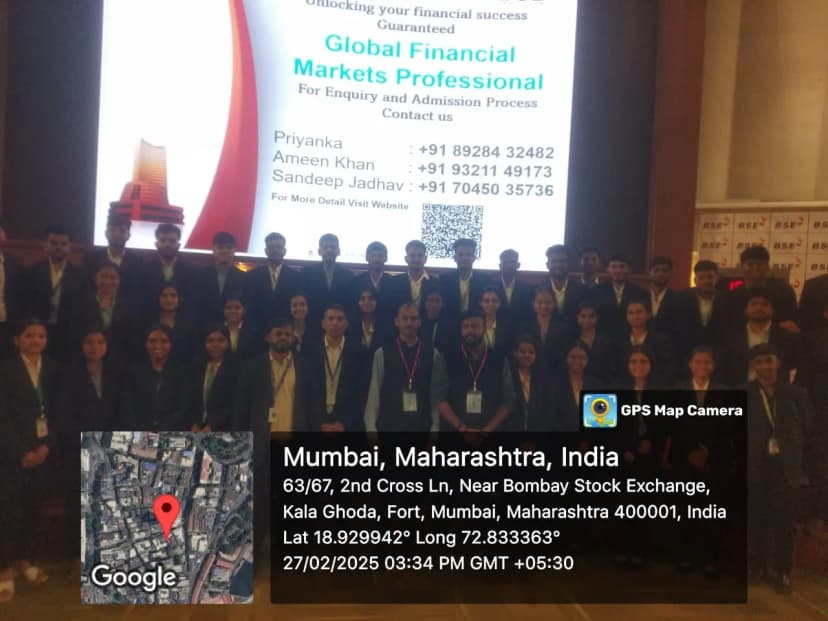
National Stock Exchange (NSE)
During their visit, students witnessed live trading sessions and attended expert talks on stock market operations, financial instruments, and regulatory frameworks. This helped them understand market dynamics, investment strategies, and the role of NSE in India’s financial ecosystem.
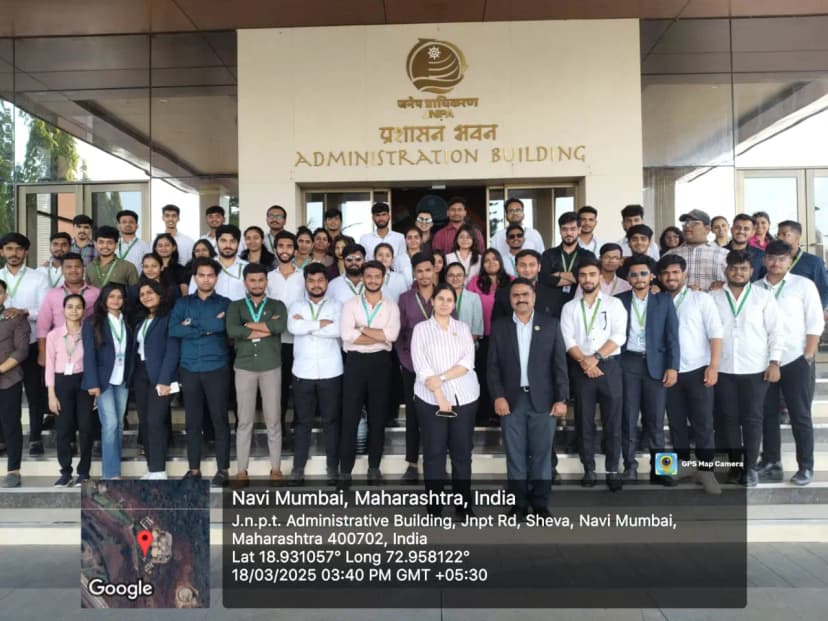
Jawaharlal Nehru Port Trust (JNPT)
Students gained a comprehensive view of logistics and international trade operations at one of India’s largest ports. They learned about cargo management, shipping procedures, port logistics, customs operations, and the critical role ports play in global commerce.
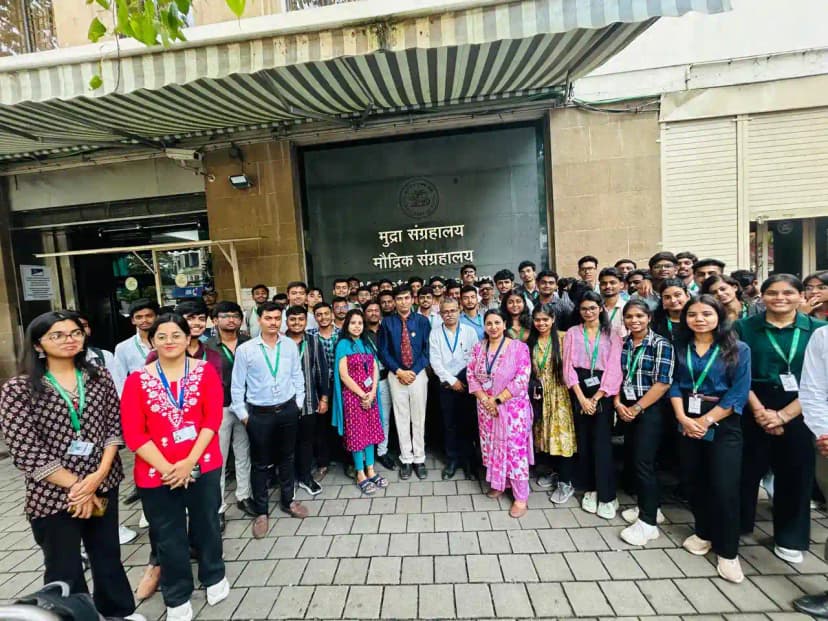
Reserve Bank of India (RBI)
At the RBI, students were introduced to India’s monetary policy mechanisms, currency management, banking regulations, and the overall role of the central bank in maintaining financial stability. They also explored how economic policies impact everyday banking and national development.
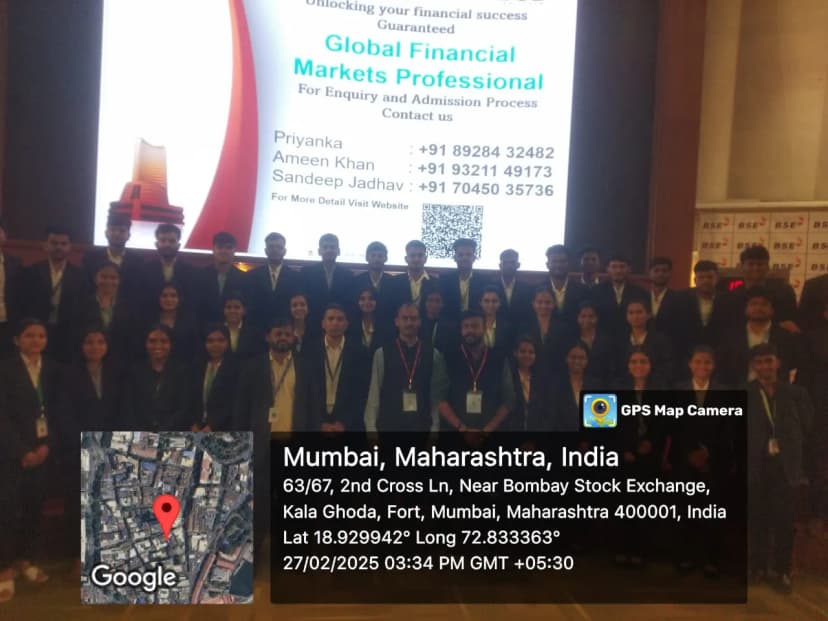
Bombay Stock Exchange (BSE)
The visit to BSE, Asia’s oldest stock exchange, offered students a deep dive into stock market history, electronic trading platforms, and risk management practices. They interacted with industry experts and learned how BSE supports capital market growth and innovation.
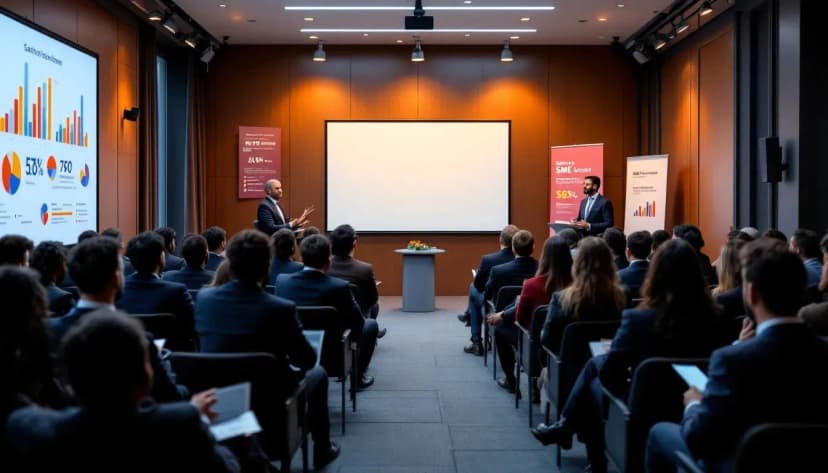
Maratha Chamber of Commerce
Students engaged with business leaders and entrepreneurs through interactive sessions, understanding real-time challenges faced by businesses today. They also gained exposure to initiatives supporting SMEs, startups, and policy advocacy efforts for economic development.
Exposure Trips
At Indira University, students participate in industrial visits that blend education with real-world exploration. These sites are where students interact with local industries, explore eco-tourism practices, and witness the beauty of nature. These visits are thoughtfully designed to offer cultural exposure, environmental awareness, and industry insights, enriching students’ academic journey through practical learning beyond the classroom.
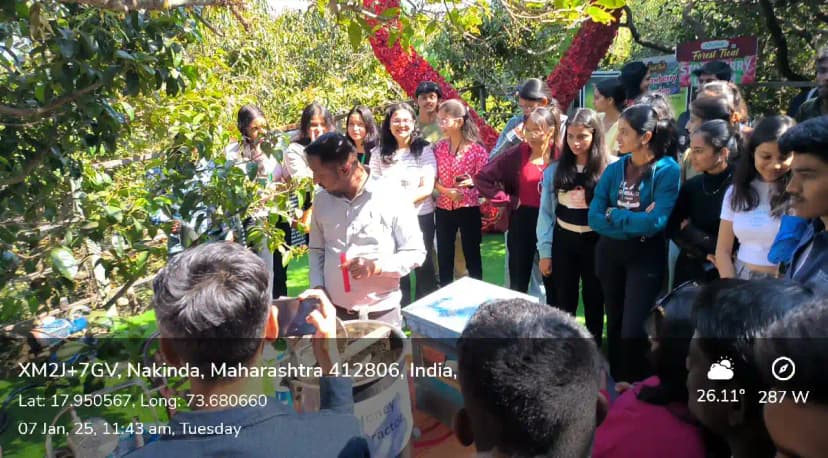
Mahabaleshwar Green Tours
The students participated in the Mahabaleshwar Green Tours organized by Indira University. This trip offered the students a chance to explore sustainable tourism, agricultural practices, and eco-friendly business models in the scenic region of Mahabaleshwar. Through visits to these farms and local food processing units, the students gained practical insights into rural entrepreneurship, supply chain management, and food development. Interactive sessions with locals and guided tours provided them with a real-world understanding of how businesses thrive and grow. They also learned community engagement and responsible business practices.
Career Opportunities
B.Sc. (Economics) graduates understand economic systems, analyze data, and evaluate policies to solve real-world problems. Equipped with strong analytical and quantitative skills, they interpret market trends and assess financial risks. Whether in finance, policy, research, or consulting, they help organizations make informed decisions and drive economic growth on both national and global levels.
The career opportunities for the students of B.Sc. (Economics) include:
Economic Analyst
Financial Consultant
Market Research Analyst
Policy Advisor
Investment Analyst
Data Analyst
Risk Analyst
Banking Professional
Business Journalist
Public Sector Economist
Research Associate
Corporate Strategy Associate
International Trade Specialist
Academic or Lecturer (with higher studies)
Economist in Government or International Org.
Apply for B.Sc. (Economics)
The application process at Indira University is designed to be straightforward and transparent. Each stage, from filling out the application form to final submission, is clearly outlined, providing applicants with a seamless and hassle-free experience as they apply to various programs.
Higher Secondary School Certificate (10+2) or its equivalent Examination with English.
Or
Three-Year Diploma Courses after S.S.C. i.e., 10th standard, of the Board of Technical Education conducted by the Government of Maharashtra or its equivalent.
Or
Two-Year Diploma in Pharmacy after HSC, of the Board of Technical Education, conducted by the Government of Maharashtra or its equivalent.
Or
Intermediate Commerce/Arts examination from the Board of Secondary Education, M.P., Bhopal, with 4 subjects including General English.
Or
H.S.C. Vocational.
Our Scholarships
Indira University is dedicated to providing equal educational opportunities for all. We offer a range of scholarships to students from economically disadvantaged backgrounds, ensuring that financial constraints do not hinder their academic ambitions. This initiative allows students to fully concentrate on their studies and future career goals.

A B.Sc. in Economics offers a strong scope in analytics, finance, policy research, consulting, banking, and corporate strategy. Graduates can also pursue higher studies like M.Sc., MBA, public policy, or data-focused roles.
Yes. A B.Sc. in Economics is ideal for students who enjoy data, logic, and problem-solving. It builds strong analytical, quantitative, and decision-making skills that are highly valued across finance, analytics, and policy-driven industries.
A B.Sc. in Economics is an undergraduate degree focused on economic theory, statistics, econometrics, and data analysis. It helps students understand markets, policies, and economic behaviour using mathematical and analytical frameworks.
B.Sc. Economics is more quantitative and data-driven, while BA Economics is theory-oriented. Students interested in analytics, finance, and research usually prefer a B.Sc., whereas a BA suits those inclined towards humanities and policy studies.
B.Sc. Economics focuses on an analytical and data-based understanding of markets, while the BBA focuses on management and business operations. B.Sc. suits students targeting analytics, finance, or policy roles; BBA suits those aiming for management careers.
The admission process includes meeting eligibility criteria, filling out the online application form, paying the application fee, checking the merit list, receiving the admission offer letter, confirming admission, and commencing the course as per the academic schedule.
Indira University combines a strong economics curriculum with data analytics, econometrics, and practical exposure. Experienced faculty, industry-aligned learning, research focus, and career support make it a strong choice for economics aspirants.